Choosing the right education board for your child is one of the most important decisions parents make today. With changing exam patterns, NEP implementation, skill-based learning, and increasing global exposure, selecting from the many school boards across India can feel overwhelming—often leaving parents wondering which board is best in India for their child’s academic growth and future success. From national boards to international curricula, every school board follows a unique learning approach, syllabus structure, and academic focus. This is why many parents compare options like the CBSE vs ICSE vs IB Curriculum & more to understand differences in academic depth, assessment style, and future opportunities before making a choice for their child’s future.
This guide is designed to help parents clearly understand the available options, explain the different school boards in India, and provide a practical comparison of India’s leading school boards. By aligning current academic expectations with real parent concerns, this content helps you make a confident and well-informed admission decision.
How Many Boards Are There in India?
A very common question parents ask is: How many boards are there in India? Officially, there are more than 30 recognized boards of education in India, including national boards, state boards, and international boards operating in the country. When people search about the number of school boards in India or the Different school boards in India, they usually refer to school-level boards that conduct examinations for Classes 10 and 12. These boards manage the curriculum, exams, certification, and school affiliation.
Broadly, school boards in India fall into three categories:
- National education boards
- State-level boards of education
- International boards in India
Understanding the various school boards in India helps parents shortlist the right type of board based on mobility, affordability, and long-term academic goals.
Education Boards in India: Complete Overview
Indian school education boards define the academic structure, assessment pattern, and teaching approach followed by schools. Each school board follows a specific syllabus in India and aligns learning outcomes with higher education pathways.
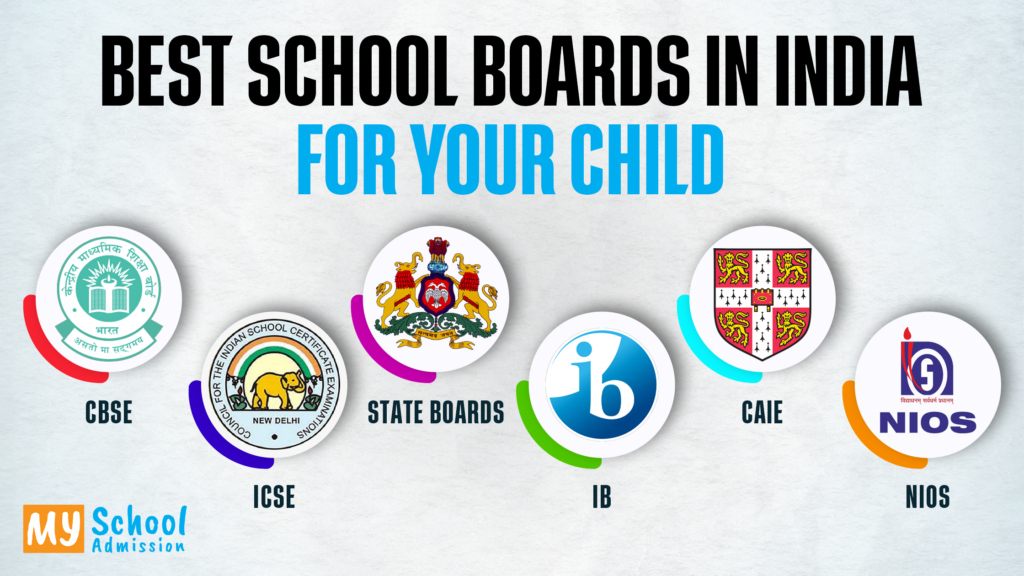
At present, Major school boards in India include:
- Central boards like CBSE and ICSE
- Open schooling boards like NIOS
- State boards governed by individual states
- International boards such as IB and CAIE
Parents often compare Types of school boards in India to identify the best school board in India for competitive exams, global exposure, or holistic development.
Types of Education Boards in India
There are multiple types of Board of schools in India, and understanding them clearly helps parents make informed decisions.
- National Boards in India
National boards follow a uniform syllabus across the country and are accepted by universities nationwide.
CBSE (Central Board of Secondary Education)
CBSE is the largest and most popular school board in India. The CBSE Board name is closely associated with structured academics and national-level entrance exams.
Key features:
- NCERT-based syllabus
- Strong alignment with JEE, NEET, CUET
- Emphasis on conceptual clarity
CBSE is often considered the best board in India for education for students targeting engineering and medical careers.
ICSE (Indian Certificate of Secondary Education)
ICSE Board offers a detailed and application-oriented curriculum.
Key features:
- Strong English language focus
- Balanced academics with arts and sciences
- Practical-based evaluation
ICSE is preferred by parents seeking depth in subjects and strong communication skills.
NIOS (National Institute of Open Schooling)
NIOS provides flexible education for students needing non-traditional learning paths.
- State Boards of Education in India
Each Indian state has its own board of education in India, commonly known as the State Board. The state board full form varies by region but operates under the respective State Education Department.
Key features:
- Regional language focus
- State-level syllabus
- Cost-effective education
Parents often ask which state board is best in India, but the answer varies depending on academic rigor and university acceptance.
- International Boards in India
International boards in India are gaining popularity due to global recognition and future-ready learning methods.
IB (International Baccalaureate)
IB emphasizes inquiry-based and skill-driven education.
Key features:
- Global curriculum
- Project-based assessments
- Strong international university acceptance
CAIE (Cambridge Assessment International Education)
Also known as the CAIE board, this curriculum is flexible and globally benchmarked.
Key features:
- Conceptual understanding
- International syllabus
- Widely accepted abroad
International boards are often listed among the best education boards in the world.
Types of Syllabus in India
Different India’s recognised school boards follow different types of syllabus in India, shaping how students learn and perform academically.
Common types of syllabus include:
- Concept-based syllabus (CBSE)
- Application-oriented syllabus (ICSE)
- Inquiry-based syllabus (IB, CAIE)
- Regional syllabus (State boards)
Understanding the school syllabus in India helps parents choose the right type of board in school for their child’s learning style.
Comparison of Major School Boards in India (2026)
To help parents make an informed decision, a side-by-side comparison highlights the key differences between various varieties of school boards in India.
| School Board | Curriculum Style | Assessment Pattern | Competitive Exam Readiness | Global Recognition | Best Suited For |
| CBSE | Concept-based, structured | Written exams + internal assessments | Very High (JEE, NEET, CUET) | Moderate | Students preparing for Indian competitive exams |
| ICSE | Detailed, application-oriented | Theory + practicals | High | Moderate | Strong academics & English proficiency |
| State Board | Region-focused syllabus | Exam-based | Medium | Low | Affordable education & state universities |
| IB | Inquiry-based, skill-driven | Projects & internal assessments | Low | Very High | International universities & holistic learning |
| CAIE | Flexible, concept-focused | Exams + coursework | Medium | Very High | Global exposure with subject flexibility |
| NIOS | Flexible & self-paced | On-demand exams | Low | Moderate | Alternative & open schooling paths |
This comparison of school boards in India helps parents confidently choose the right education board for their child based on academic goals, learning preferences, and long-term plans.
Which Board Is Best in India for Your Child?
There is no single school board that fits every child. The right choice depends on the student’s learning style, academic goals, and future plans.
- For competitive exams in India: CBSE
- For academic depth and language skills: ICSE
- For affordability and regional focus: State boards
- For international exposure: IB or CAIE
Parents often wonder which education board is most suitable because this decision is personal and has long-term implications.
How Many Boards Are There in India for School Education?
Revisiting the question about the number of school boards in India, it is important to note that while over 30 boards exist, only a few dominate school education.
Major school boards in India include:
- CBSE
- ICSE
- State Board
- IB
- CAIE
- NIOS
This provides a practical overview of the different India’s school management boards for parents when choosing schools.
Final Conclusion
Choosing among education boards in India is a crucial decision that shapes a child’s academic foundation and future opportunities. My School Admission helps parents make this process easier by providing comparison options and a smart search tool to explore different school boards, curricula, and schools. By understanding the various school boards in India, evaluating curriculum strengths, and using these tools to compare options, parents can confidently select the most suitable board for their child.
The best school board is not necessarily the most popular one — it is the board that aligns with your child’s learning style, career aspirations, and long-term goals. With the right guidance, parents can make informed decisions quickly and effortlessly, ensuring every child finds the right fit for their academic journey.